




How to put in contact lenses: steps for beginners
The steps for putting in contact lenses, how to tell if a lens is inside out, and the hygiene habits that matter most.
New articles by email
One email a week.
The short answer, from the American Academy of Ophthalmology (AAO): wash and dry your hands, rinse the lens with contact lens solution (never tap water), check it isn't torn or inside out, hold your lids open, place it while looking ahead or up, then blink and check it's centred.
The first few times you put in contact lenses, it can take a while and a lot of blinking. That's normal. With a steady routine, it usually becomes quick. Your optometrist or optician should show you how in person when you're first fitted; this guide is a reminder of the steps the American Academy of Ophthalmology (AAO) describes.
If drops are part of your routine, how to put in eye drops covers the steps, and dry eyes when flying covers lenses on long flights.
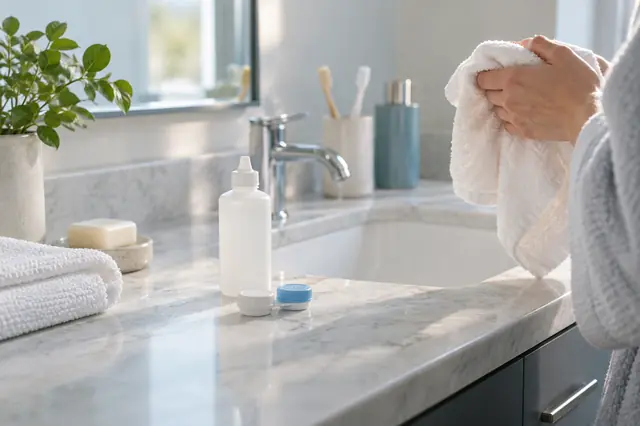
Before you start
- Wash your hands. The AAO advises avoiding soaps with added oils or fragrances, which can stick to the lens. Dry your hands well.
- Short nails help. Handle lenses with your fingertips, not your nails. The AAO suggests beginners keep nails short to avoid scratching the eye.
- Work over a clean, flat surface. If you drop a lens, it's easier to find.
How do you put in contact lenses?
- Take it out of the caseShake the case gently if the lens sticks, then slide it out.
- Rinse with solutionUse contact lens solution. Never tap water.
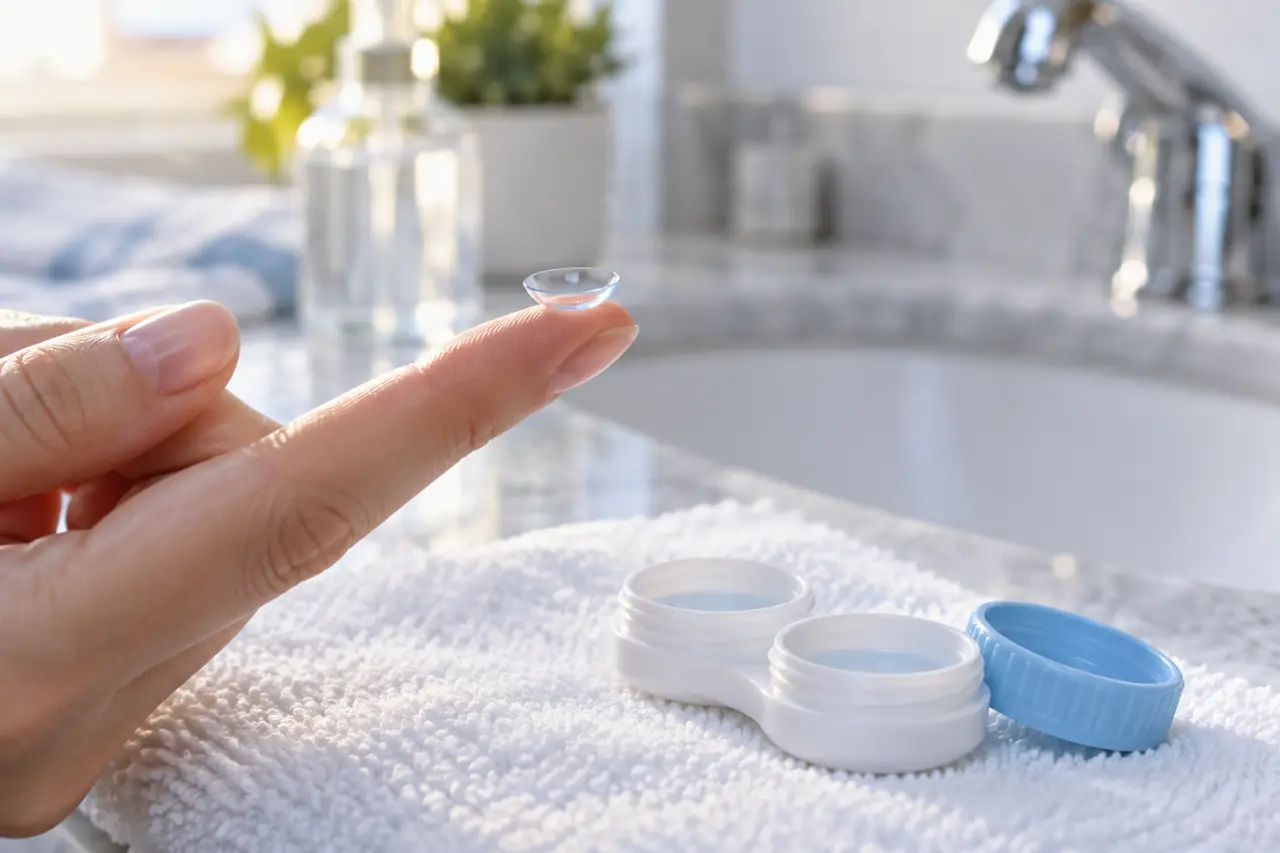
- Check itOn your fingertip, look for tears and check it isn't inside out.
- Open your lidsHold the upper lid with one hand and pull the lower lid down with the other.
- Place itLook straight ahead or up at the ceiling and set the lens on your eye.
- Settle itClose your eyes slowly, roll them, blink a few times and check in a mirror it's centred.
Beginner problems at a glance
Common first-week snags and what the AAO says about each. Your optometrist or optician can show you what suits your lenses.
| What happens | What the AAO says |
|---|---|
| The lens sticks to the case | Shake the case gently to loosen it, then slide the lens into your hand |
| You can't tell if it's inside out | A bowl with the edges turned up is ready; a lid shape with the edges turned out needs reversing |
| You mix up the right and left lenses | Always put the first lens in the same eye |
| It doesn't feel right after it goes in | Close your eyes slowly, roll them, blink a few times and check in a mirror that it's centred. A centred lens should feel comfortable and you should see clearly |
| You worry it slipped behind your eye | It can't: a membrane connects your eye to your eyelid |
| You're afraid of scratching your eye | Handle lenses with your fingertips, not your nails, and keep nails short as a beginner |
| Your eyes feel dry with lenses | Use rewetting drops as your eye doctor recommends, and remember to blink at screens. See contact lenses that feel dry at the computer |
A red, painful eye, blurred vision or sensitivity to light while wearing lenses is different: take the lenses out and get seen the same day (see below).
Is it inside out?
If it's inside out, rinse it with solution, turn it the right way and check again before putting it in.
Taking lenses out
The AAO says to always start by washing your hands. Your optometrist will show you the method that suits your lens type. Then clean and store the lenses as your care system says, or throw them away if they're daily disposables.
Habits that matter most
- Never rinse or store lenses in tap water
- Don't sleep in lenses unless your eye care professional has prescribed them for it
- Take lenses out before swimming or showering
- Use fresh solution every time; never top up old solution
- Replace the case regularly
- Replace lenses on the schedule you were given
To know when a pair is due, enter the day you opened it in the free contact lens replacement date calculator. The AAO says sleeping in contact lenses raises the risk of a serious eye infection six to eightfold. Our post on contact lens habits covers the research, and swimming and your eyes explains why water and lenses don't mix.
Caring for your lens case
The case matters as much as the lenses. The CDC recommends rubbing and rinsing lenses in disinfecting solution each time you take them out, using fresh solution every time, cleaning the case with solution (not water), letting it dry upside down with the caps off, and replacing it at least every three months. In a CDC survey, more than 82 percent of wearers kept their case for longer than recommended.
Makeup and lenses
Glitter and metallic makeup can irritate the eye's surface, especially in contact lens wearers, according to the AAO. Apply makeup outside the lash line and keep products fresh. See eye makeup and eye hygiene.
When to take lenses out and see someone
- Lenses feel uncomfortable or dry most days
- Your vision with lenses seems blurrier
- Your eyes are often red after wearing them
- A red, painful eye while wearing lenses
- Blurred vision that doesn't clear when lenses are out
- Sensitivity to light
- Discharge from the eye
Read more by topic
Common questions
How do I know if my contact lens is inside out?
Balance it on a fingertip and look from the side. A bowl with edges turned up is ready. If the edges flare out like a lid, it's inside out.
Can I rinse contact lenses with tap water?
No. The American Academy of Ophthalmology says to rinse lenses with contact lens solution, never tap water.
Should I look up or straight ahead when putting in contacts?
The American Academy of Ophthalmology says to look straight ahead or up toward the ceiling while placing the lens.
Is it safe to sleep in contact lenses?
The American Academy of Ophthalmology says sleeping in lenses raises the risk of a serious eye infection six to eightfold. Don't, unless your eye care professional prescribed lenses for it.
Sources
End of article