


What happens during an eye exam?
A step-by-step guide to a comprehensive eye exam: each test, what it checks, how long it takes, what dilation is like and how to prepare.
New articles by email
One email a week.
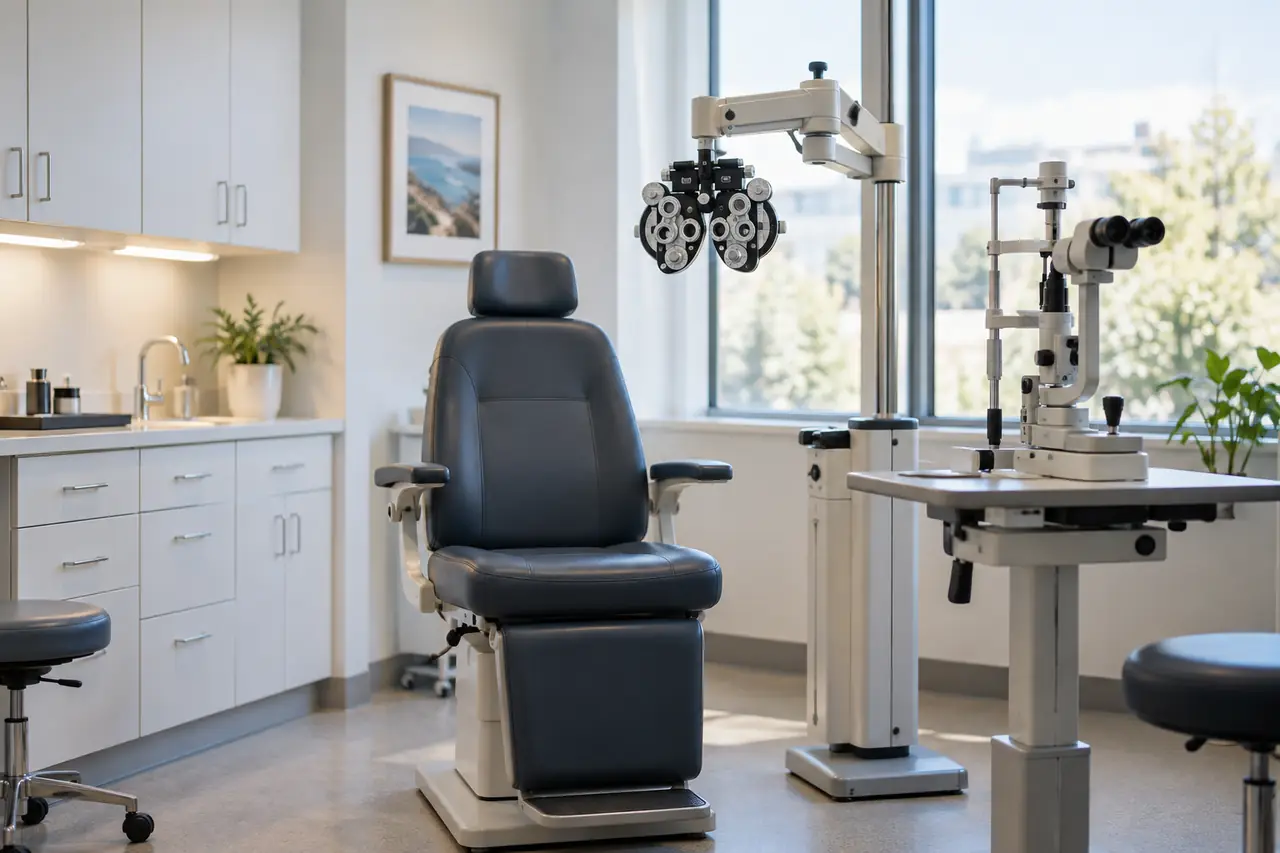
The short answer, from the American Academy of Ophthalmology (AAO): a comprehensive eye exam takes 45 to 90 minutes and covers your health history, letter charts, finding your lens power, checks of your pupils, eye movements, side vision and eye pressure, and a look at the front and back of the eye.
If you haven't had a full eye exam in a while, or ever, it helps to know what's coming. Some parts may be done by a member of staff before you see the doctor.
It's more than reading letters off a chart. The National Eye Institute (NEI) describes a dilated eye exam as the only way to check for eye diseases early on, because many cause no symptoms at first.
Optometrist vs ophthalmologist vs optician explains who does which exam, and how to describe vision changes helps you prepare.
What happens during an eye exam, step by step?
- HistoryYour vision, general health, medicines, family history and glasses or lenses.
- Letter chartsOne eye at a time, at a distance and up close.
- RefractionLenses flipped in front of you to find your best prescription.
- PupilsA light shone in each eye to see how the pupils react.
- Eye movementsFollowing a target to check alignment and eye muscles.
- Side visionA check of your visual field, which can change without you noticing.
- Eye pressureA puff of air or a gentle touch, sometimes after numbing drops.
- Front of the eyeA slit-lamp microscope to look at the lids, cornea, iris and lens.
- Back of the eyeOften after dilating drops, a look at the retina and optic nerve.
What the tests look for
- Letter charts measure how sharp your vision is. See what 20/20 vision means.
- Refraction finds the lens power that gives you the clearest vision. "Which is clearer, one or two?" is this part.
- Pressure checks measure the pressure inside the eye, which the AAO notes can be a sign of glaucoma.
- Side vision matters because, as the AAO puts it, you can lose side vision without noticing.
- The dilated exam lets the doctor see the retina and optic nerve. The American Optometric Association (AOA) notes it can also reveal signs of some conditions elsewhere in the body.
Your eye doctor may add other tests, such as scans or photos of the back of the eye, if earlier results call for them.
Eye exam tests at a glance
What each common test is, what it checks and what you do, as the AAO, the National Eye Institute (NEI) and the American Optometric Association (AOA) describe them.
| Test | What it checks | What you do |
|---|---|---|
| Letter chart | How sharp your vision is, far and near (AAO) | Read letters with one eye covered, then the other |
| Refraction | The lens power that gives your clearest vision (AAO) | Say which of two lenses looks clearer |
| Pupil check | How your pupils react to light (AAO) | Look ahead while a light is shone in each eye |
| Eye movements | Alignment and the eye muscles (AAO) | Follow a target with your eyes |
| Side vision | Your visual field, which can change without you noticing (AAO) | Say when you see something at the edge of your sight |
| Eye pressure | Pressure inside the eye, which can be a sign of glaucoma (AAO) | Sit still for a puff of air or a gentle touch, sometimes after numbing drops |
| Slit lamp | Lids, cornea, iris and lens (AAO) | Rest your chin on a support while the doctor looks through a microscope |
| Dilated exam | Retina and optic nerve (NEI, AAO); the AOA notes it can also show signs of some conditions elsewhere in the body | Wait 20 to 30 minutes after drops, then look where asked |
Dilation
The AAO says it usually takes 20 to 30 minutes for the drops to open the pupils fully. Afterwards, your vision may be blurry, especially up close, and bright light may bother you. The NEI says this lasts a few hours, and both the NEI and AAO suggest bringing sunglasses and arranging a ride home. See how long eye dilation lasts.
An eye exam is not a screening
The AOA points out that vision screenings, for example at school or for a driving licence, often test only distance sharpness, and can miss focusing, eye teamwork and eye health problems. It says screenings can't replace regular professional eye care.
How to prepare
- Your glasses, and your contact lenses or their box
- A list of medicines and supplements you take
- Your family's eye history, if you know it
- Notes on any symptoms: what, when, how often
- Your questions, written down
- Sunglasses, and a ride home if you'll be dilated
The NEI suggests writing your questions down before you go, and asking the doctor to write down the main points. The printable questions for my eye appointment sheet has this list and space for your own questions. If you've kept dated notes or photos, for example in Ocufuse, the Doctor Brief (Ocufuse Plus) turns a date range into a summary you can hand over. See what to tell your eye doctor and your family eye health history.
How often to go
Recommendations vary by country, age and risk. Our post on how often you should get your eyes checked summarises them.
Read more by topic
Common questions
How long does an eye exam take?
The American Academy of Ophthalmology says a comprehensive eye exam shouldn't take more than 45 to 90 minutes.
What tests are done in an eye exam?
History, letter charts, refraction, pupil checks, eye movements, side vision, eye pressure, a slit-lamp look at the front of the eye and often dilation to look at the retina and optic nerve.
Does an eye exam hurt?
The tests are generally painless. The pressure check may use a brief puff of air or a gentle touch, sometimes after numbing drops.
Is a vision screening the same as an eye exam?
No. The American Optometric Association says screenings often test only distance sharpness and can miss focusing, eye teamwork and eye health problems.
Sources
End of article