





What does 20/20 vision mean?
The two numbers in 20/20 and 20/40 explained, what 6/6 means, and the parts of your vision and eye health a letter chart doesn't measure.
New articles by email
One email a week.
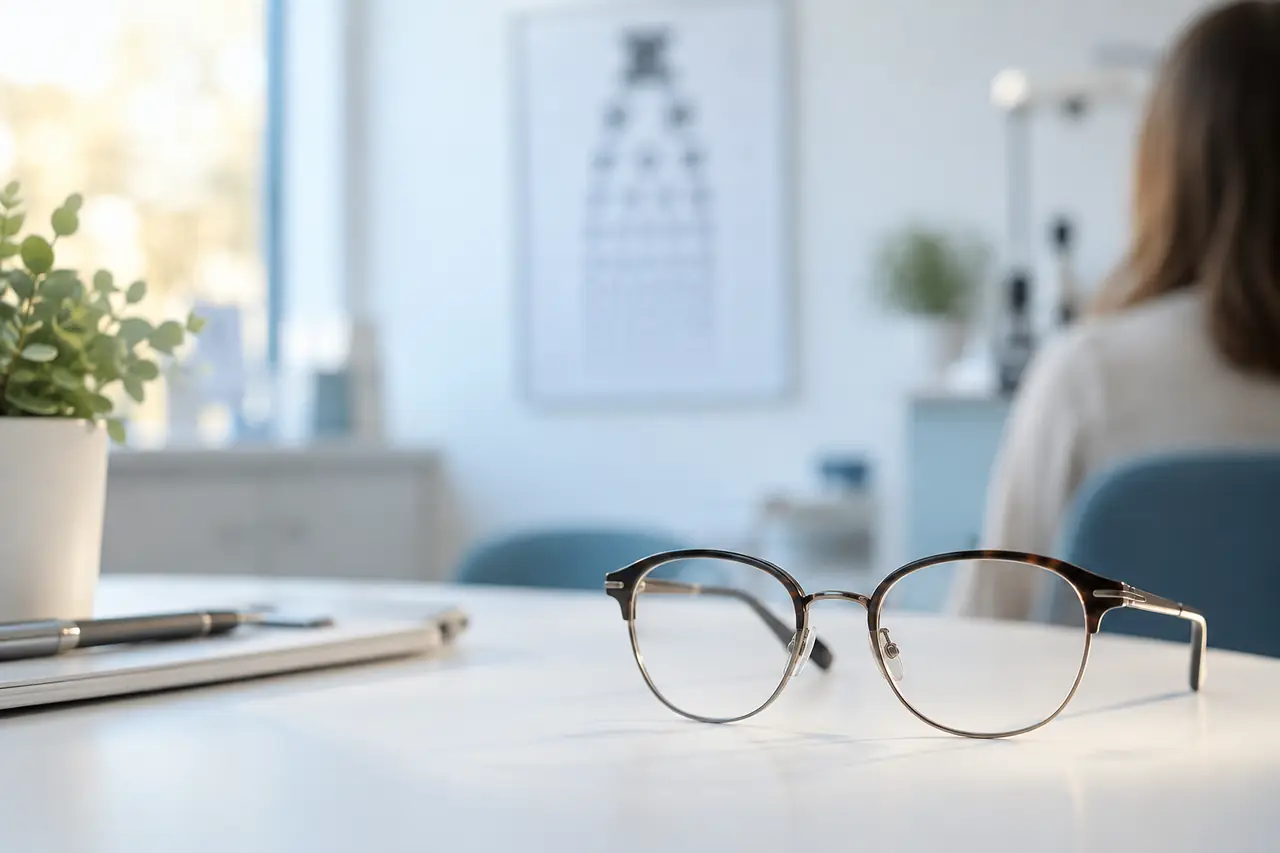
20/20 vision means that from 20 feet away you can read the line a person with typical sight reads from 20 feet. The American Academy of Ophthalmology explains that the top number is your distance from the chart and the bottom number is the distance at which typical eyes read the same line. It measures sharpness at a distance, not perfect vision.
"20/20" has become shorthand for perfect eyesight, but it means something more specific. The American Optometric Association (AOA) describes 20/20 as a term for normal visual acuity, the sharpness of your vision, measured at a distance of 20 feet. It's a useful number. It just doesn't tell the whole story.
Astigmatism and how to read a glasses prescription cover what is measured when the chart isn't sharp. The eye guides A to Z has a one-line definition of visual acuity.
What do the two numbers in 20/20 mean?
Cleveland Clinic explains it like this:
- The first number is how far you are from the chart. In standard testing, that's 20 feet.
- The second number is the distance at which a person with typical sight could read the same line.
What does 20/40 vision mean?
- 20/20: at 20 feet you can read what a person with typical sight reads at 20 feet.
- 20/40: at 20 feet you can read what they could read from 40 feet away. Your distance vision is less sharp than typical.
- 20/100: the AOA's example. You need to be at 20 feet to see what a person with typical sight sees from 100 feet.
- 20/15: at 20 feet you can read what they'd need to be at 15 feet to read. That's sharper than typical.
So a bigger second number means less sharp distance vision. Your results may be recorded with and without glasses or contacts, so ask which is which.
What is 6/6 vision?
Countries that use metres measure from 6 metres instead of 20 feet, so 20/20 is written 6/6, according to Cleveland Clinic. 6/12 is the metric version of 20/40.
Vision scores at a glance: feet and metres
The same scores written both ways. The metric version keeps the ratio and tests from 6 metres instead of 20 feet; the meanings come from the sources listed at the end.
| Feet (US) | Metres | What it means | Source |
|---|---|---|---|
| 20/15 | 6/4.5 | Sharper than typical: you read at 20 feet what typical eyes need to be at 15 feet to read | Cleveland Clinic, AAO |
| 20/20 | 6/6 | Typical sharpness at a distance | AOA, Cleveland Clinic |
| 20/30 | 6/9 | A little less sharp than average | AAO |
| 20/40 | 6/12 | At 20 feet you see what typical eyes see from 40 feet | Cleveland Clinic |
| 20/100 | 6/30 | You need to be at 20 feet to see what typical eyes see from 100 feet | AOA |
| 20/200 | 6/60 | 20/200 or worse with glasses or contacts is the level the AAO gives for being "legally blind" | AAO |
A score on its own is not a diagnosis. Only an eye exam can say what a result means for you.
Is 20/20 perfect vision?
- How sharp your distance vision is
- With or without your glasses or contacts
- Colour vision
- Side (peripheral) vision
- Eye coordination and depth perception
- Focusing up close
- Night vision
- The health of your eyes
No. Cleveland Clinic stresses that 20/20 doesn't mean your vision is perfect, and the American Academy of Ophthalmology says the same. The AOA lists side vision, eye coordination, depth perception, focusing ability and colour vision as other important vision skills. Someone can read the 20/20 line and still find small print up close hard, as with presbyopia, the near-focus change most people notice from their mid-forties.
Just as important, many eye conditions cause no change in sharpness early on. That's why a full eye exam includes much more than reading letters. See what happens during an eye exam.
How common is 20/20 vision?
Cleveland Clinic says only about 35 percent of people in the world have 20/20 vision without glasses, contact lenses or eye surgery. The American Academy of Ophthalmology gives the same 35 percent for adults, and says about 75 percent of adults have 20/20 vision with correction. The National Eye Institute says refractive errors (nearsightedness, farsightedness, astigmatism and presbyopia) are the most common type of vision problem, affecting more than 150 million Americans. See nearsighted vs farsighted.
Charts at home and online
Printable charts and online vision tests can give a rough idea of sharpness, but they're not eye exams. They can't check eye health, and results depend on the screen, the lighting and the distance. If a home check makes you wonder about your vision, book an eye test.
When to see someone
Book an eye test if distance vision seems blurrier than it used to, if you squint to read signs or subtitles, or if your last check was a while ago. Our post on how often to get your eyes checked covers timing.
Read more by topic
Common questions
What does 20/20 vision mean?
At 20 feet, you can read what a person with typical sight can read at 20 feet. The American Optometric Association describes it as normal sharpness of distance vision.
Is 20/40 vision bad?
It means you need to be at 20 feet to read what a person with typical sight can read from 40 feet, so your distance vision is less sharp than typical. An eye exam can find out why and whether glasses help.
What is 6/6 vision?
The metric version of 20/20, measured from 6 metres instead of 20 feet.
Does 20/20 mean perfect vision?
No. Cleveland Clinic says 20/20 doesn't mean your vision is perfect. It doesn't measure colour vision, side vision, depth perception, focusing up close, night vision or eye health.
How many people have 20/20 vision?
Cleveland Clinic says only about 35 percent of people in the world have 20/20 vision without glasses, contact lenses or surgery.
Sources
End of article