


Is it bad to sleep with a sleep mask every night?
Sleeping in a mask every night is fine for most adults. Learn the exceptions (pressure, a dirty mask, babies) and how to choose a mask that keeps off your lids.
New articles by email
One email a week.
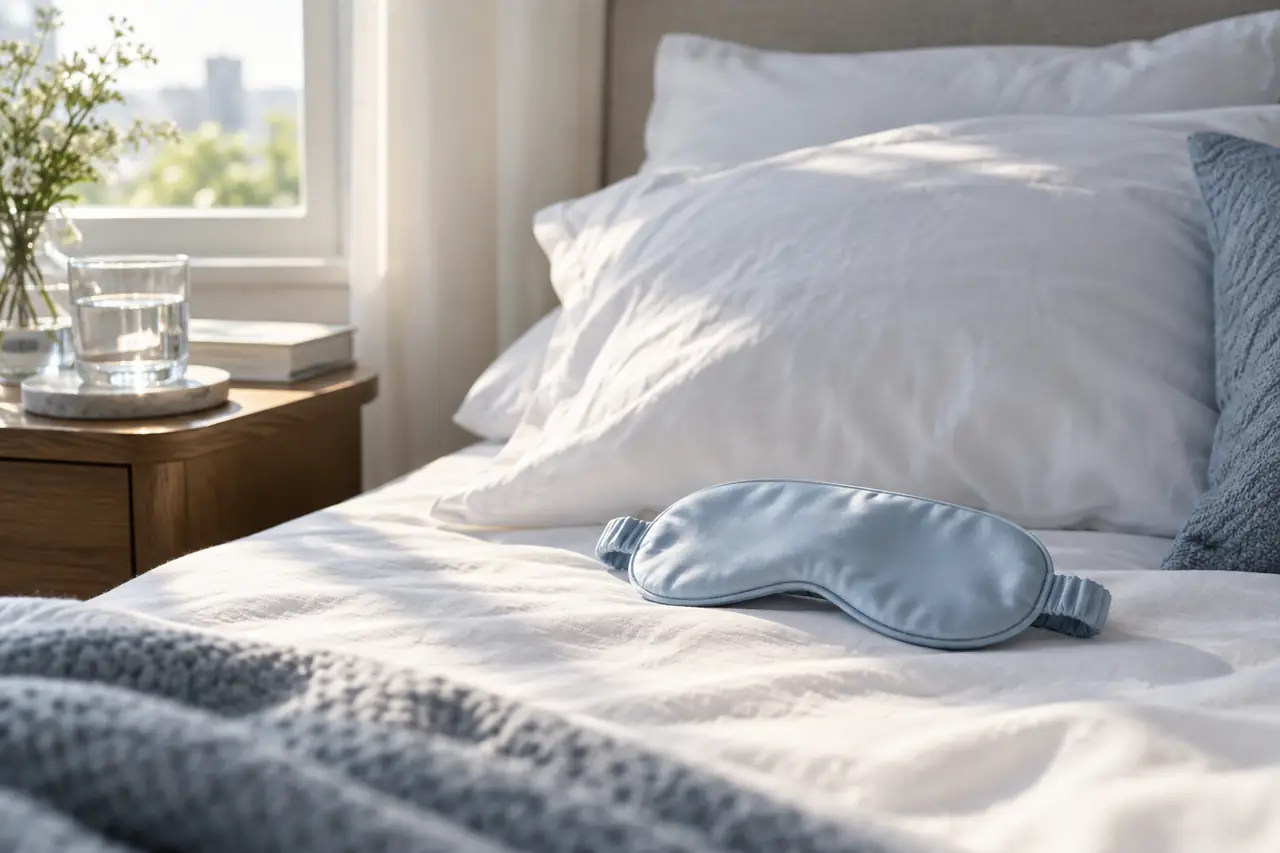
For most adults, no. A sleep mask that fits well and doesn't press on your eyes is generally considered safe to wear every night, and the main things to keep an eye on are pressure, a mask that's getting grubby, and keeping masks away from babies.
A common question on sleep forums goes like this: I've worn a mask every night for months, it helps me stay asleep when the sun comes up at 5 am, but I've started wondering whether all that pressure is doing something to my eyes. That worry is reasonable, and it mostly comes down to fit.
For the wider picture on light, screens and sleep, see sleep, screens and tired eyes. If your vision is often blurry first thing, blurry vision in the morning covers the usual everyday reasons.
What the research on masks has found
Studies on sleep masks are small, but a few are worth knowing about.
- Everyday sleep. In a 2023 study in the journal Sleep, from Cardiff University, 89 adults aged 18 to 35 spent a week sleeping with a light-blocking mask and a week with no mask or a mask with holes cut over the eyes. After the mask week, they scored slightly higher on a next-day word-pair memory test and, in the first experiment, had faster reaction times. They didn't sleep any longer (about 8.2 hours either way) and didn't rate their sleep as better.
- A noisy, bright room. In a 2010 lab study of 14 healthy adults played recorded intensive care noise under 100 lux of light, wearing earplugs and an eye mask together went with more REM sleep, fewer arousals and better rated sleep than the same noise and light without them.
- Hospital intensive care. A 2015 Cochrane review found low-certainty evidence that earplugs, eye masks or both may increase total sleep time for patients in intensive care units.
None of these studies looked at the eyes themselves, and an intensive care unit is very different from a bedroom. What they do suggest is that blocking light is the point of a mask. If your room is already dark, a mask may add little.
Pressure on the eyes is the thing to watch
A medically reviewed guide from All About Vision says a correctly fitting eye mask is generally safe for adults to sleep in. It adds that the steady pressure of a tight mask may cause blurred vision when you wake up, and lists a mask that's too small as a cause of pressure, blurry vision or headache.
Signs your mask may be too tight:
- Your vision is a little blurry for a while after you take it off.
- You wake with marks around your eyes or across your temples.
- You get a dull headache that eases once the mask is off.
- The fabric presses on your closed eyelids rather than resting on the bone around them.
Loosening the strap is the first thing to try. If the mask still sits on your eyelids, a different shape usually helps more than a tighter fit. The same guide says to see an eye doctor if blurriness after wearing a mask lasts longer than 24 hours.
Contoured or flat: how they differ
Most masks fall into two shapes. Neither suits everyone, so it's mainly about how you sleep.
- Moulded cups sit away from the eyes
- Room to blink and open your eyes
- Less contact with lashes
- Often blocks light well around the nose
- Can feel bulky when lying on your side
- Thin and soft, folds into a bag
- Often comfortable for side sleepers
- Rests on the eyelids, so fit matters more
- Light can creep in at the nose
- Usually easy to wash
All About Vision describes contoured masks as usually made of lightweight foam shaped around the eyes and nose, and notes that the shape lets you blink comfortably with less chance of eyelash damage or fallout. If you wear lash extensions or just dislike anything touching your eyelids, that's the shape to try first.
What to look for in a mask you'll wear nightly
- Nothing presses on your closed eyelids
- An adjustable strap you can loosen
- Blocks light at the nose bridge
- Soft, breathable material that suits your skin
- Washable, or with a cover that comes off
- Comfortable in your usual sleeping position
Sizes vary a lot between masks, so a mask that's comfortable for one person can press on another person's eyes. If you can, try it lying down in your usual position before deciding it fits.
Keeping it clean matters when it's on your face for eight hours a night. All About Vision notes that masks collect sweat, oil, makeup and dirt, and suggests washing yours regularly following the care instructions. How often should you wash a sleep mask goes into more detail.
Who should skip a mask, or ask first
- Babies. Sleep masks aren't recommended for infants because of the suffocation risk. For older children, All About Vision suggests keeping them for non-routine sleep, such as a nap in the car.
- After eye surgery or with an eye condition. If you've had eye surgery, use ointment at night or have been told to protect an eye while you sleep, ask your eye care team whether a mask suits you and which kind.
- Sore or irritated eyes. If a mask seems to make your eyes or eyelids uncomfortable, stop using it for a few nights and see whether that changes anything.
Read more by topic
Common questions
Is it safe to wear a sleep mask every night?
For adults, a correctly fitting mask is generally considered safe to sleep in, according to a medically reviewed guide from All About Vision. The main things to watch are pressure on the eyes and keeping the mask clean.
Can a sleep mask make my vision blurry?
A tight mask that presses on the eyes all night may leave vision blurry when you wake up. A looser strap or a contoured mask usually takes the pressure off. If blurriness lasts more than a day, see an eye doctor.
Are contoured sleep masks better than flat ones?
Neither is better for everyone. Contoured masks have cups that sit away from the eyes, which leaves room to blink. Flat masks are thinner and often more comfortable for side sleepers.
Can children wear sleep masks?
Sleep masks aren't recommended for babies because of the suffocation risk. For older children, they're best kept for things like naps while travelling rather than every night.
Sources
- All About Vision (medically reviewed): Are all eye masks safe to sleep in?
- Greco V et al., Sleep, 2023: Wearing an eye mask during overnight sleep improves episodic learning and alertness
- Hu RF et al., Critical Care, 2010: Effects of earplugs and eye masks on nocturnal sleep, melatonin and cortisol in a simulated intensive care unit environment
- Cochrane, 2015: Non-drug treatments for promoting sleep in adults in the intensive care unit
End of article