





Why do my glasses keep sliding down my nose?
Usually the frame is loose at the temples, the bridge is too wide, or skin oil makes the pads slip. An optician can adjust most frames in minutes.
New articles by email
One email a week.
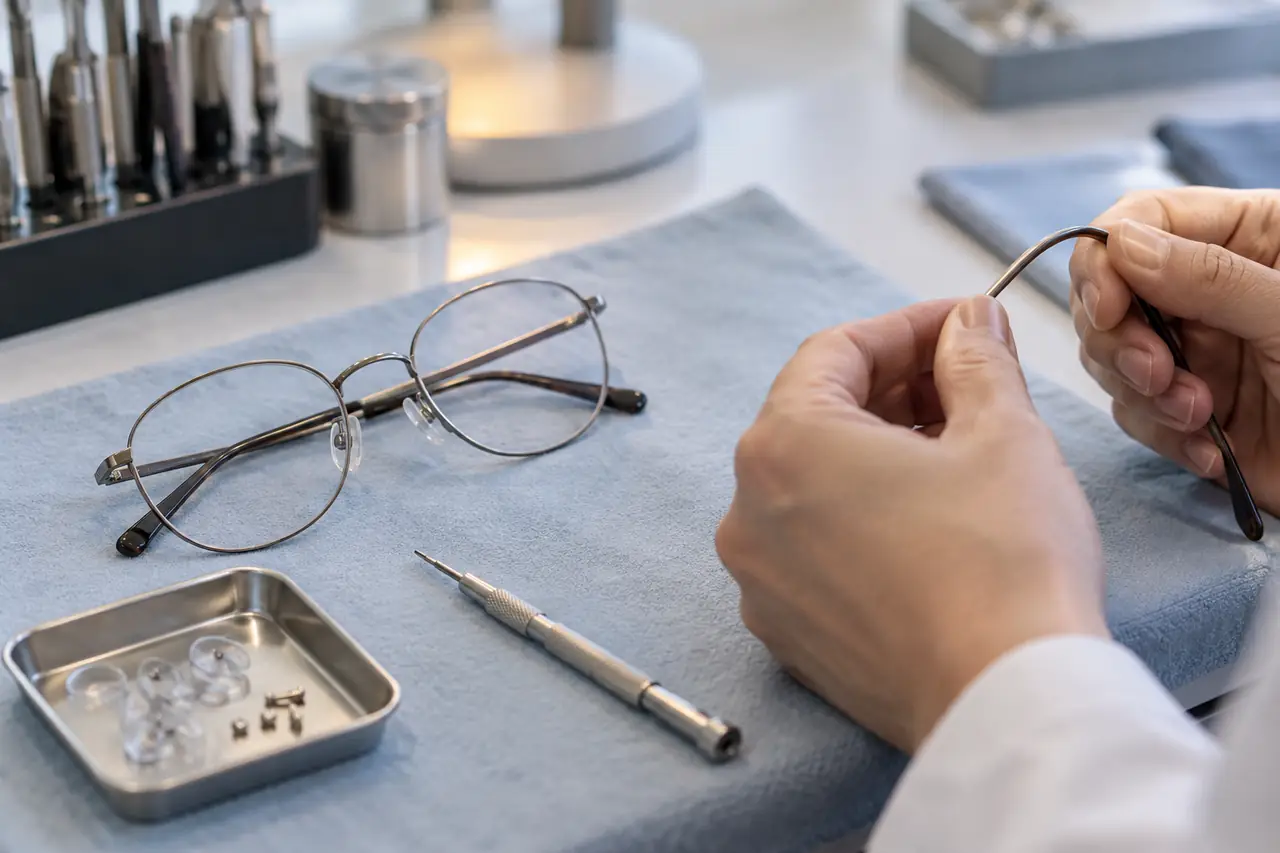
Glasses usually slide down because something in the fit has changed. The arms have loosened and no longer grip behind your ears, the bridge or nose pads don't match the shape of your nose, or skin oil, sweat and warmth make the frame slip.
A common question goes like this: I spend half the day pushing my glasses back up with one finger, they were fine when I bought them, and now they slide every time I look down at my phone or my keyboard. That pattern, fine at first and loose a few months later, points to a frame that has gradually opened up. It's one of the most common things opticians fix.
If your glasses are new and something feels off, how long it takes to adjust to new glasses covers what's normal. For who does what, see optometrist, ophthalmologist or optician.
How glasses are meant to sit
Glasses rest on three points: the bridge of your nose and the top of each ear. When those three points hold, the frame stays put.
Cambridge University Hospitals NHS gives simple fit points in its advice on children's glasses, and they work for adults too. The glasses should sit so you look through the centre of the lenses. The arms should loop behind the ears, which helps stop the glasses sliding down your nose. And if they're too tight or too loose, take them back to the optician for an adjustment.
- Your eyes sit roughly in the middle of each lens, not near the top.
- The frame is level and doesn't tip to one side.
- The arms touch the sides of your head lightly and curve down behind your ears.
- The bridge or pads rest on your nose without pinching or leaving deep marks.
- The glasses stay in place when you look down at your feet.
The usual reasons they slide
- Arms have spread from taking glasses off one-handed
- Hinge screws have worked loose
- Usually fixed by bending the arms back in at the ear
- Bridge too wide for your nose
- Low nose bridge with a frame made for a higher one
- Pads can be moved, swapped or added on many frames
- Heavy lenses or a big frame pull it forward
- Oil, sweat and make-up make the pads slip
- Lighter lenses or a smaller frame next time
Arms loosen with use. Taking glasses off with one hand, pushing them up onto your head or sleeping in them gradually opens the frame out. Once the arms no longer press gently on the sides of your head, there's nothing holding the frame back when you look down.
The bridge matters too. Frames with built-in plastic bridges have a fixed shape. If your nose bridge is lower or narrower than the frame was designed for, the glasses rest further down and slide more easily. Frames with adjustable nose pads can be fine tuned in a way a solid bridge can't.
Heavier lenses, for example in a strong prescription, and larger frames put more weight at the front. And warmth, skin oil, sunscreen and make-up all make the contact points slippery, which is why many people notice their glasses slide more in summer or during exercise.
Why fit is more than comfort
Lenses are made so that their optical centre lines up with your eyes. When the frame drifts down, you end up looking through a different part of the lens. For a mild single vision prescription you may not notice. The American Academy of Ophthalmology (AAO) explains that progressive lenses and stronger prescriptions are much more sensitive to small errors in position.
Progressive lenses are a good example. Cleveland Clinic says they need correct fitting to give the best vision, because the different strengths sit in small, precise areas of the lens. If a progressive pair slides, you may find yourself tipping your head back to read, because the reading zone has moved.
What you can do, and what to leave to an optician
- Tighten loose hinge screws. A small eyeglass screwdriver is cheap. If the screw keeps working loose, an optician can replace it.
- Clean the nose pads and the bridge. Washing the frame with a little mild soap and water removes oil that makes pads slip.
- Take them off with two hands. It keeps the arms from spreading out again.
- Ask about pads or ear grips. Silicone nose pads, adhesive bridge pads for plastic frames and soft sleeves for the arm tips are widely sold. They can help, but they won't make up for a frame that's the wrong size.
- Leave the bending to an optician. Metal arms and pad arms can snap if they're bent cold, and plastic frames are often warmed before they're reshaped. Cleveland Clinic notes that an eye doctor or optician can adjust or repair frames. Many do it for free, especially for frames they sold.
If you're choosing a new frame, try it on and look down at the floor, shake your head gently and smile. If it moves a lot in the shop, it'll move more after a few months.
If your nose or ears hurt, or the frame leaves sore marks, let your optician know rather than waiting for it to settle. And if your vision feels wrong even when the glasses are sitting where they should, book an appointment with an eye care professional to have the prescription and measurements checked.
Read more by topic
Common questions
How should glasses fit on your face?
They should sit so you look through the centre of the lenses, with the arms going behind your ears. Cambridge University Hospitals' advice for children's glasses describes both of these, and the same goes for adults.
Can I tighten my own glasses?
A loose screw at the hinge is easy to tighten with a small screwdriver. Bending the arms or nose pads is better left to an optician, because metal can snap and plastic frames often need gentle heat to reshape.
Does it matter if my glasses sit low on my nose?
It can. Lenses are made so the optical centre lines up with your eyes. The American Academy of Ophthalmology notes that progressive lenses and stronger prescriptions are more sensitive to small errors in position.
How much does an adjustment cost?
It varies. Many opticians adjust frames for free, especially ones they sold. It's worth asking before you buy a new pair.
Sources
End of article