



How do I measure my PD to buy glasses online?
PD is the distance between the centres of your pupils, in millimetres. Ask your eye doctor or optician first; a ruler and mirror is the backup.
New articles by email
One email a week.
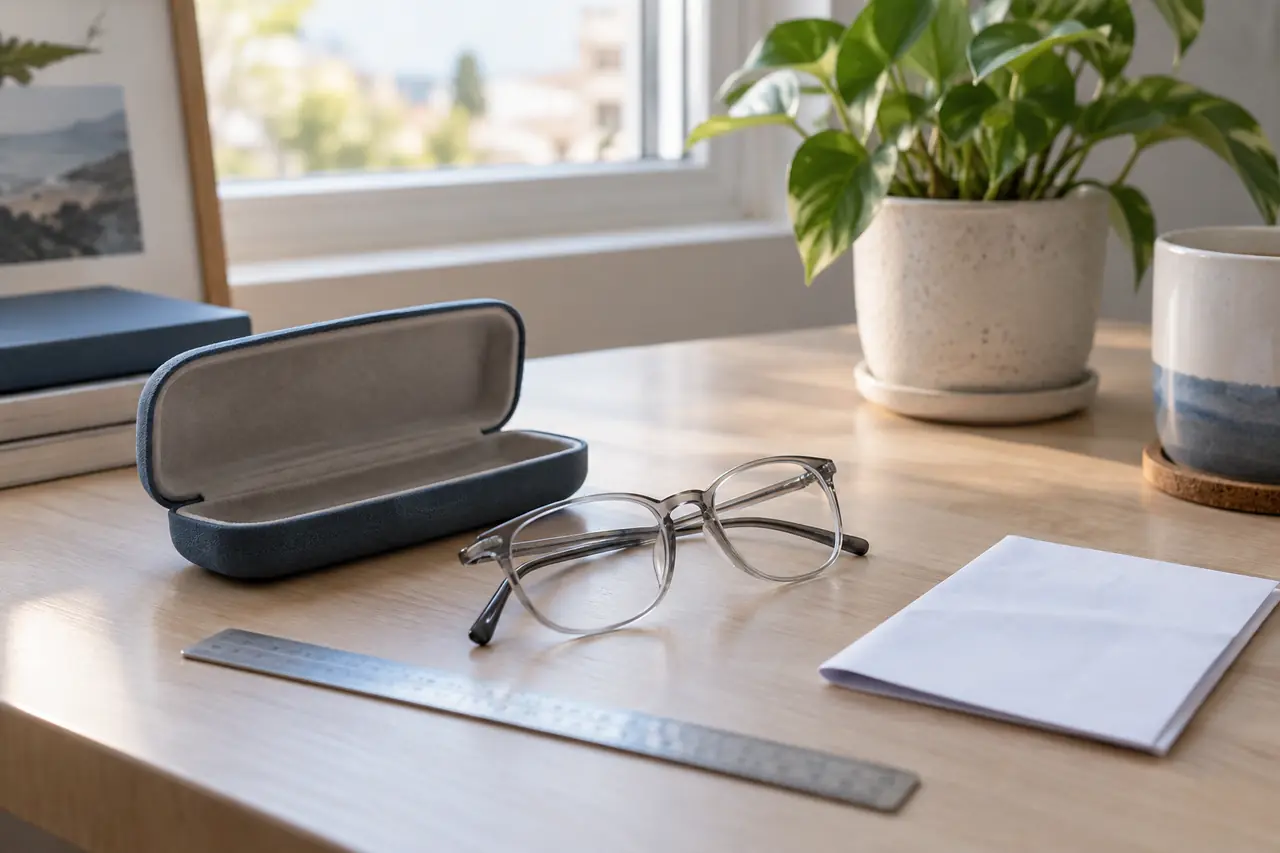
PD, short for pupillary distance, is the distance between the centres of your two pupils, measured in millimetres. Online shops use it to place the optical centre of each lens in front of each eye, and the most reliable way to get it is to ask the eye doctor or optician who tested your eyes to measure it.
A common question goes like this: I have my prescription, I found frames I like online, and the order form wants a number I've never heard of, so can I just measure it myself with a ruler? You can, and for many simple prescriptions that's enough. It helps to know when a home measurement is fine and when it isn't.
For the other numbers on the form, see how to read your glasses prescription. Once the new pair arrives, how long it takes to adjust to new glasses covers the first few days.
Why the number matters
Every lens has an optical centre, the point where you see through it most clearly. If that point doesn't line up with your pupil, the lens bends light slightly sideways as well as focusing it. How much that matters depends on the lens.
The American Academy of Ophthalmology (AAO) puts it plainly: PD can be measured very close to exact, and whether an error causes symptoms depends on the strength of the prescription and the size of the error. Progressive lenses in a high prescription are sensitive to small PD errors. Single vision glasses with a low prescription may cause no symptoms even with a significant error.
Cleveland Clinic notes that you need your PD to order glasses online, and that an accurate measurement helps make sure the glasses are made properly.
The easiest way: ask for it
Cleveland Clinic says some US states require PD on the prescription, but most don't. Ask at your eye exam, or call the practice afterwards; it may already be in your record from your last pair. An optician can also measure it in a minute with a ruler or a small device. Some practices charge for it if you're not buying from them, so it's fair to ask first.
Some optical shops will measure it for you from glasses you already own and are happy with, as long as they were made with an accurate PD.
Measuring it yourself with a ruler and a mirror
If you can't get it from a practice, this is the method many online shops describe. You need a ruler with millimetre markings and a mirror, or a second person, which is easier.
- Stand about 20 cm from a mirror in good lightTake your glasses off and look straight ahead.
- Hold the ruler flat against your browKeep it level, just above your eyes, and don't let it tilt.
- Close your right eyeLine up the zero mark with the centre of your left pupil.
- Close your left eye and open your rightWithout moving the ruler or your head, read the mark at the centre of your right pupil. That's your PD.
- Repeat three or four timesIf your readings differ, use the number that comes up most often.
With a helper, sit facing each other at the same height. Look at something across the room, past their shoulder, while they hold the ruler and read the distance between your pupil centres. Looking into the distance matters, because your eyes turn inward slightly when you focus on something close, so the number gets smaller.
That's also why reading glasses use a slightly smaller near PD. If you're ordering glasses only for reading and the shop asks for a near PD, it's better to get it from an optician than to guess.
Many shops also offer a measurement using your phone or webcam with a card for scale. Results depend on the camera, the light and how still you hold, so treat it like the ruler method and repeat it a few times.
Single vision, progressives and what else to check
- Single vision glasses
- Low to moderate prescription
- Frames similar in size to a pair you already wear
- Progressives or bifocals, which also need a fitting height
- Strong prescriptions
- Prism on your prescription
The research on online glasses has improved over time. In a 2011 study in the journal Optometry, 44.8% of 154 pairs ordered from online vendors failed at least one optical or impact test. A 2021 study in Optometry and Vision Science, reported by Review of Optometry, found failure rates of about 8 to 11% across three online vendors, and no impact failures. The College of Optometrists says that in its research, incorrect self-measurement was one reason more online pairs were rated unacceptable, and that high street varifocals ranked higher for fit.
Before you order, check that your prescription is current, that you've typed each number into the right box for the right eye, and that the frame size is close to a pair that already fits you. Cleveland Clinic also suggests reading the warranty and remake terms, so you know what happens if the glasses aren't right.
Online eye tests are a separate question from PD. The AAO points out that online tests can measure prescription power but can't check the health of your eyes, which an in-person exam does. If your new glasses still feel wrong after the first week or so, or you get headaches or discomfort that doesn't settle, take them to an eye care professional to have the prescription and the PD checked.
Read more by topic
Common questions
Is PD on my glasses prescription?
Sometimes. Cleveland Clinic says some US states require it on the prescription, but most don't. You can ask your eye doctor or optician to measure it and write it down.
What's the difference between single PD and dual PD?
Single PD is the whole distance from one pupil centre to the other. Dual PD gives each eye's distance from the middle of your nose separately, which helps when your face isn't perfectly symmetrical. If a shop asks for dual PD, measure each side.
Does PD have to be exact?
Not always. The American Academy of Ophthalmology says a low single vision prescription may cause no symptoms even with a noticeable error, while progressives in a strong prescription are sensitive to small errors.
Should I buy progressives online?
The College of Optometrists says high street varifocals ranked higher for fit and preference in its research. Progressives also need a fitting height, which is hard to measure on yourself, so many people get them fitted in person.
Sources
- Cleveland Clinic: Eyeglasses (glasses), how they work and types
- American Academy of Ophthalmology: Does the pupillary distance and axis have to be exact?
- College of Optometrists: Buying spectacles online (position statement)
- Citek and others, Safety and compliance of prescription spectacles ordered by the public via the Internet, Optometry, 2011 (PubMed)
- Review of Optometry: Online vendors getting better at spectacle Rx results (report on Gordon and others, Optometry and Vision Science, 2021)
- American Academy of Ophthalmology: Getting a glasses prescription online, what you should know
End of article