





How to use a warm compress on your eyes safely
Hold a clean cloth or heated eye mask, warm but not hot, on closed eyelids for about 5 to 10 minutes. How often, heated masks, and what to avoid.
New articles by email
One email a week.
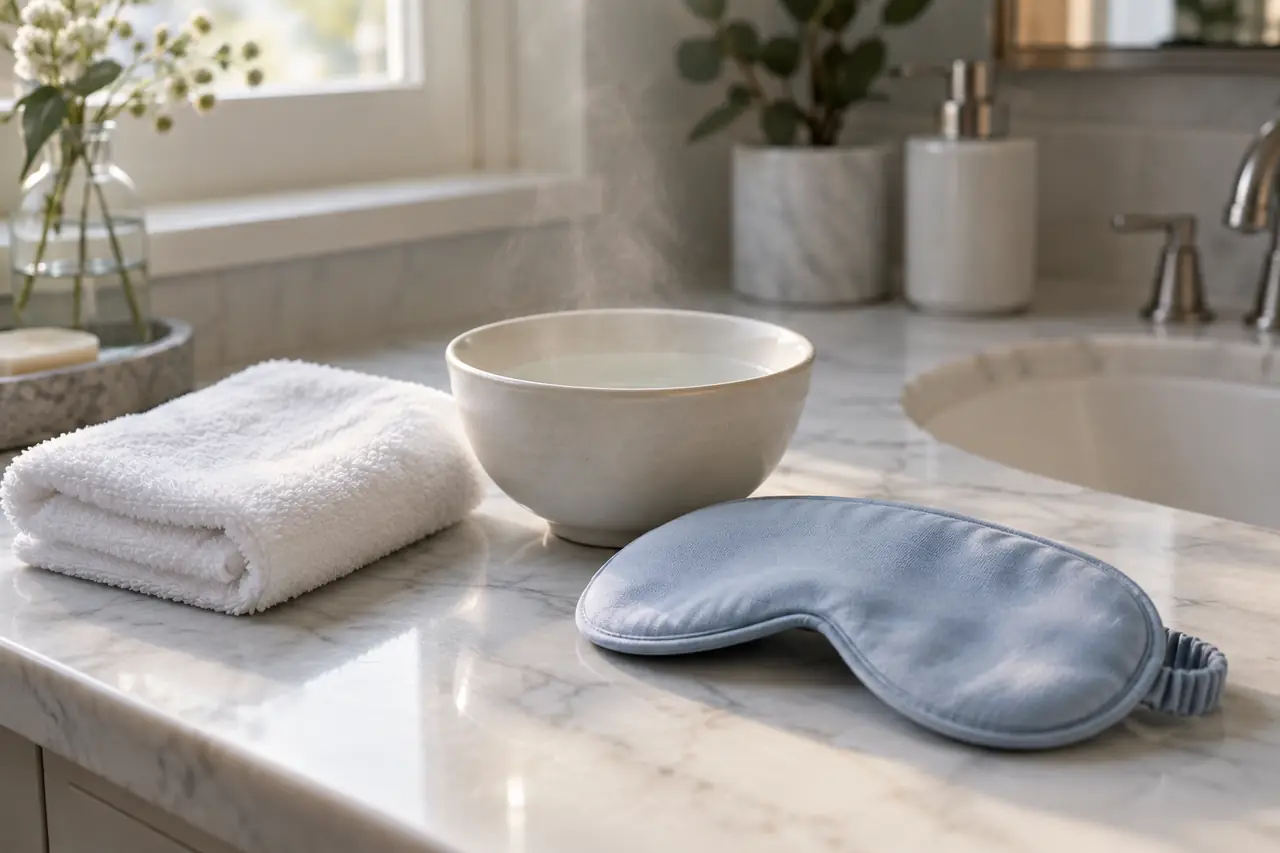
Soak a clean cloth in warm water, wring it out and hold it on your closed eyelids for about 5 to 10 minutes, re-warming it when it cools. The two rules that matter most are warm, never hot, and clean hands and cloth every time.
A common question goes like this: my pharmacist told me to use warm compresses, but nobody said how hot, how long or whether one of those microwave masks is the same thing. Health service leaflets answer most of that, though they don't all give the same numbers.
If your eyelids are often crusty when you wake, see crusty eyes in the morning. For dryness that's worst first thing, see dry eyes in the morning.
Why people are told to use one
Warm compresses come up most often in advice about styes and about blepharitis, where the edges of the eyelids get sore and crusty. Ireland's health service (HSE) lists a warm compress among the things you can do yourself for a stye. NHS hospital leaflets on blepharitis use warmth to soften the oil in the glands along the lid edge before cleaning it.
Some people also use a warm mask simply because it feels comfortable at the end of a long screen day. That's fine, as long as the heat stays gentle. A warm compress is a home comfort measure. It doesn't replace an examination if something is wrong.
How to do it with a cloth
- Wash your handsUse a freshly washed face cloth or flannel.
- Warm, not hotSoak it in warm water, then wring it out.
- Test on your wristIf it feels hot on the inside of your wrist, let it cool.
- Eyes closedRest it on your closed eyelids for about 5 to 10 minutes.
- Re-warm as neededDip it again when it cools. Use a clean cloth next time.
A cloth cools quickly, which is why one Cambridge University Hospitals leaflet says to keep re-warming it in the bowl of warm water so it doesn't go cold. Some leaflets add a gentle massage of the lid edges afterwards, or cleaning along the lash line. Those steps come from the person treating you, so only add them if you've been shown how.
Keep the cloth for your face only, and don't share it. The HSE advises not sharing towels or face cloths with someone who has a stye.
How long and how often
This is where the guidance varies, because it depends on why you're doing it.
- For a stye, the HSE says to hold a warm cloth on the eye for 5 to 10 minutes, 3 or 4 times a day.
- As part of a blepharitis routine, the Cambridge leaflet uses around 5 to 10 minutes, morning and evening. The Moorfields Eye Hospital leaflet uses 3 minutes, twice a day, straight before cleaning the lids.
- On longer sessions, an ophthalmologist answering a reader question for the American Academy of Ophthalmology said most ophthalmologists suggest about 5 minutes at a time, usually two to four times a day, and that there's no set maximum. He noted that continuous heat can widen blood vessels and may add to eyelid swelling, so longer isn't always better.
If you were given a routine by an optometrist, GP or pharmacist, follow theirs. If a routine runs over weeks, a short note of how often you managed it and how your eyes felt is useful at a follow-up visit. The dry eye diary post has a simple layout.
Heated and microwavable eye masks
Reusable eye masks filled with gel, beads or grains do the same job as a cloth and tend to hold their warmth longer. The Moorfields leaflet mentions a microwavable eye bag as an option alongside a hot flannel, and warns to take care not to burn your skin. There are also single-use self-warming masks and plug-in or USB heated masks.
- Heat it for exactly the time on the packet
- Shake or knead it to spread the heat
- Test it on the inside of your wrist
- Keep your eyes closed while it's on
- Use it for the set time, then take it off
- Stop if it feels hot, stings or leaves the skin red
Microwaves heat unevenly, so a mask can feel fine on the outside and hold hot spots inside. Never heat it longer to save time, don't fall asleep with a heated mask on unless its instructions say it's designed for that, and replace it if the cover splits or the filling leaks. A cold or cooling mask is a different product with its own instructions.
What to avoid
- Water or masks that feel hot rather than warm.
- Squeezing or popping a stye. The HSE says that can spread the infection.
- Eye makeup and contact lenses while a stye heals, which the HSE also advises against.
- Pressing hard on your eyeballs. The compress should rest on your lids, not push into them.
- Reusing the same cloth without washing it.
Read more by topic
Common questions
How long should I keep a warm compress on my eyes?
Most guidance gives about 5 to 10 minutes at a time. One NHS hospital leaflet uses 3 minutes as part of a lid cleaning routine. Follow the time your doctor or pharmacist gave you.
How hot should a warm compress be?
Warm, not hot. Leaflets don't give a number; they say to take care not to burn your skin. Test it on the inside of your wrist first, and let it cool if it feels hot there.
Can I use a microwavable eye mask instead of a cloth?
Yes, many eye leaflets mention microwavable eye bags. Follow the heating time on the packet exactly, check for hot spots and test it on your wrist before it goes on your eyelids.
Should I squeeze a stye after a warm compress?
No. Ireland's health service says not to pop or squeeze a stye, as that can spread the infection.
Sources
End of article